
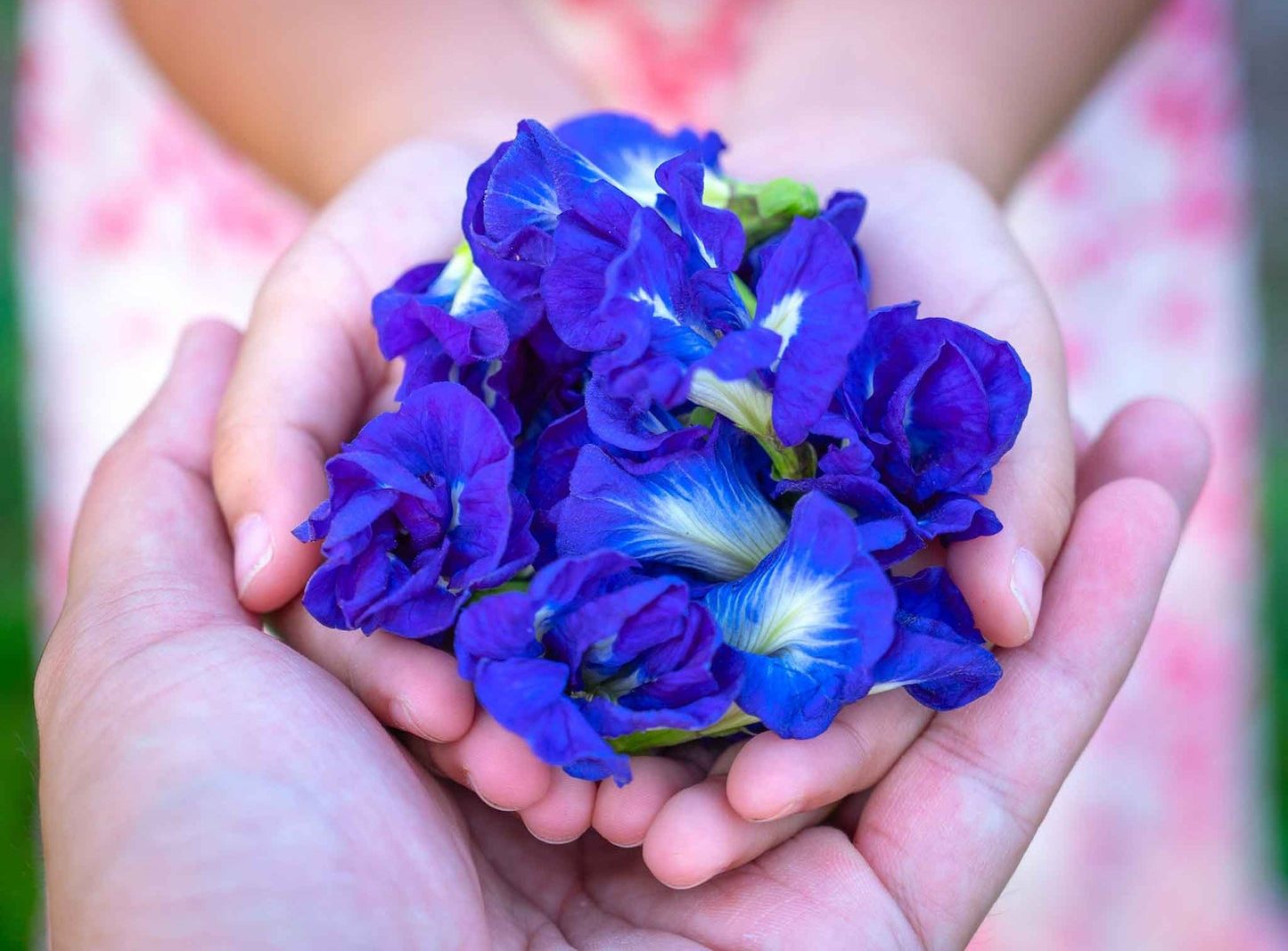

There is a specific kind of wonder that comes from watching a clear glass of tea transform from a deep, midnight blue to a vibrant violet with just a squeeze of lime. For many of us growing up in Southeast Asia, this “magic” was a childhood staple—a natural dye for our Nasi Kerabu or a cooling drink shared on a humid afternoon.
But at Khasiat, we believe that understanding the why behind the beauty makes the experience even more profound. The Butterfly Pea (Clitoria ternatea) isn’t just a pretty bloom; it is a masterclass in plant chemistry.
The Master Molecule: Polyacylated Anthocyanins
The secret to this flower’s unwavering, brilliant blue lies in a specific group of molecules: polyacylated anthocyanins, known to science as ternatins.
While many plants contain anthocyanins, the Butterfly Pea is unique because its ternatins are the most abundant and stable. These molecules are built on a base of delphinidin—the same powerful antioxidant found in blueberries. However, unlike the delphinidin in berries which can be fragile, the “polyacylated” structure of the ternatins acts like a suit of armor, protecting the color and the nutrients even when exposed to heat.
This is why our ancestors trusted this bloom for centuries; it is a blue that never fades, even under the heat of a kitchen fire.
Did You Know? The name Ternatins actually honors the flower’s heritage. The species was first described by botanists on the Island of Ternate in the Maluku Islands of Indonesia. Even in the laboratory, the flower carries the name of its tropical home.
The Alchemy of the pH Shift
We often talk about the “magic” of the color change, but it is actually a physical conversation between the flower and its environment.
When the flower’s petals are steeped in neutral water, the molecules reflect the deep blue we recognize. But the moment you add an acid—like lemon or lime—you are changing the chemical landscape. The anthocyanins react to the shift in pH by physically rearranging their structure.
C₁₅H₁₁O₇⁺ (Flavylium cation – Pink) ⇌ Anhydrobase (Blue)
As the acidity increases, the molecule shifts its reflection from blue to magenta. It is a reminder that nature is never static; it is always responding and adapting. When you drink this tea, you aren’t just consuming a beverage; you are consuming a moment of biological transformation.
Why Khasiat Matters: The Memory of My Grandma
Beyond the ternatins and the pH scales, the Butterfly Pea carries a weight that science can’t fully measure: the weight of memory.
I still remember watching my grandmother in the early morning light of her garden. Her fingers would be stained a faint, dusty blue as she carefully plucked the fresh blooms. She wasn’t thinking about “acetylcholine” or “anti-glycation” at the time; she was thinking about Pulut Tai Tai.
She would steep those petals to extract that signature indigo, marbling the glutinous rice to make my mother’s favorite kuih. For her, that blue wasn’t just a colour; it was an ingredient of care. She knew instinctively that these flowers kept the skin bright and the mind sharp—a piece of wisdom passed down through generations who understood the rhythm of the soil long before we had the lab results to prove them right.
Today, when we look at the health benefits of the Butterfly Pea, we are simply putting names to the “khasiat” our grandmothers already knew:
- A Shield for the Skin: These polyacylated anthocyanins help combat “glycation”—the process where sugar ages our skin—helping us maintain a natural glow from the inside out.
- Clarity for the Mind: Science now confirms the flower’s ability to support acetylcholine, the neurotransmitter responsible for memory and focus.
Using the Butterfly Pea is an act of preservation. Every time we brew a cup, we are bridging the gap between the quiet wisdom of our heritage and the precision of modern science. It is a reminder that the most powerful wellness secrets are often the ones tied to our fondest memories.
By Chun Ting from Khasiat
Chun Ting is a Malaysian Registered Nutritionist specializing in regional public health and metabolic wellness. Over a 20-year career spanning Southeast Asia, he knows that the secret to healthy communities isn’t found in imported wellness trends—it’s found locally. Backed by a Bachelor’s from Universiti Putra Malaysia (UPM) and a Master’s from the London School of Hygiene & Tropical Medicine (LSHTM), Chun Ting bridges the gap between complex science and daily life—translating nutritional data into fun, practical lifestyle hacks that protect both your health and your love for local food.