
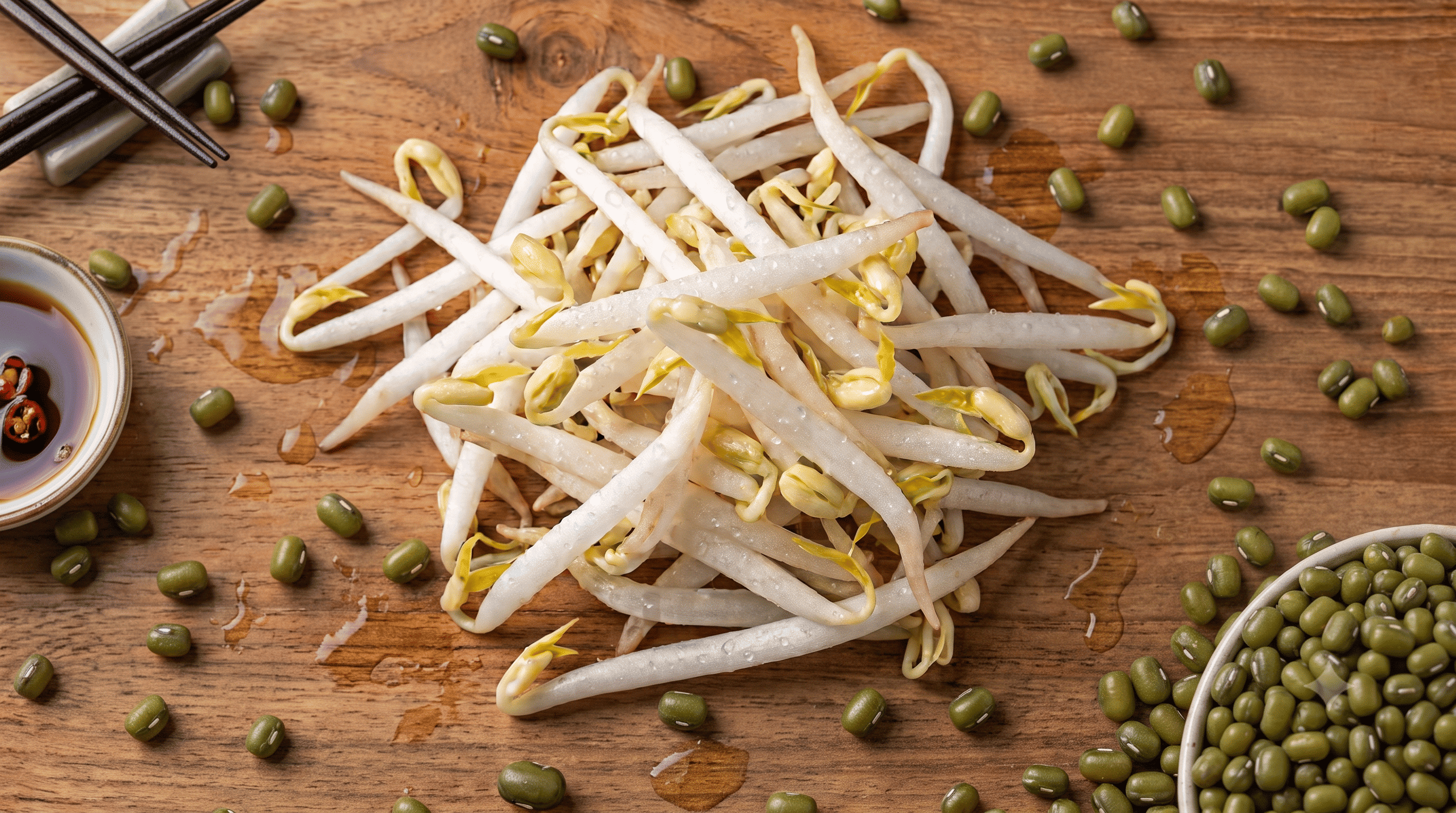

Walk into any hawker center across Southeast Asia, and you will find taugeh (mung bean sprouts) anchoring the region’s most iconic dishes. From the smoky charred strands woven through a plate of Char Kway Teow to the refreshing crunch balancing a rich bowl of Laksa or Mee Rebus, this humble vegetable is a staple of everyday dining.
Yet, because it is so incredibly common, taugeh is often taken for granted—frequently dismissed as just a cheap texture-booster or simple “crunchy water.”
When a humble mung bean undergoes the germination process to sprout a tail, it triggers a dramatic biological transformation. Far from being a mere filler ingredient, taugeh is a live, bio-activated food that leaves its boiled, unsprouted counterpart in the dust.
Sprout vs. Boiled Mung Bean
When a mung bean sprouts, it breaks down its own heavy starches to fuel its rapid growth. This biochemical shift triggers an explosion of nutrients, far outclassing the nutrient profile of standard boiled mung beans.
1. The Antioxidant Spike (Vitexin & Isovitexin)
While boiled mung beans lose a chunk of their antioxidant capacity to the cooking water, the fresh sprout goes into overdrive. Germination multiplies total phenols and flavonoids by 4.5 to 6.8 times.
- The Heavy Hitters: Taugeh floods your system with highly active flavonoids—specifically vitexin and isovitexin. These specialized antioxidants are incredibly potent free-radical scavengers, working to reduce systemic inflammation and protect your cells from long-term oxidative stress.
- The Environmental Shield: Modern clinical research demonstrates that this intensive antioxidant profile specifically targets and neutralizes oxidative damage caused by environmental toxins, heavy metals, and chemical food overexposure. By absorbing free radicals before they can attack cellular structures, taugeh actively protects vital organs—including the reproductive system—from cellular degradation.
2. Vitamin C: Up to a 24x Explosion
A standard dried or boiled mung bean contains virtually no Vitamin C. But the moment water touches the seed and the sprouting process begins, the plant starts synthesizing ascorbic acid out of thin air. The Vitamin C levels skyrocket by up to 24 times higher than the dormant seed, transforming it into a great ally for your immune system and skin collagen.
3. Vitamin K1: The Bone and Blood Architect
Boiled mung beans possess barely trace amounts of Vitamin K. However, as the sprout grows and develops its tiny yellow-green tip to prepare for photosynthesis, Vitamin K1 levels spike by roughly 400%. Just 100g of raw or lightly blanched taugeh covers nearly 30% of your daily requirement of Vitamin K1, a crucial nutrient responsible for healthy blood clotting and directing calcium into your bones rather than your arteries.
4. High-Quality, Bioavailable Protein (The 3g Rule)
100g of taugeh yields about 3 grams of highly efficient, plant-based protein. While a bowl of dense, boiled mung beans has more overall mass-weight protein, the quality of the protein in the sprout is vastly superior.
Sprouting completely dismantles protease inhibitors (compounds in regular beans that physically block your body from digesting protein) and naturally breaks heavy plant proteins down into free amino acids. You absorb those 3 grams almost immediately, enjoying maximum protein efficiency with absolutely zero digestive bloat.
The Legendary Ipoh Taugeh
While all taugeh is packed with these incredible health benefits, you cannot talk about this vegetable without mentioning the town of Ipoh, Malaysia—internationally famous for producing the absolute gold standard of bean sprouts. But why is Ipoh the best?
- The Limestone Filter: Ipoh is surrounded by majestic limestone hills. The local groundwater filters through these rock formations for years, becoming highly alkaline and heavily saturated with natural calcium and magnesium.
- The Mineral Advantage: When irrigated with this hard water, the sprouts absorb these minerals directly into their cell walls. This reinforces the plant’s structure, allowing it to hold significantly more water weight without turning mushy.
- The Result: A premium, mineral-infused sprout that delivers an unmatched, sweet, crisp crunch, proving just how much environmental factors can elevate this humble ingredient.
So the next time you visit Ipoh, order a plate of 芽菜–Nga Choi (taugeh in Cantonese), embrace the crunch, and experience how taugeh sprouting creates the absolute peak of its Khasiat.
By Chun Ting from Khasiat
Chun Ting is a Malaysian Registered Nutritionist specializing in regional public health and metabolic wellness. Over a 20-year career spanning Southeast Asia, he knows that the secret to healthy communities isn’t found in imported wellness trends—it’s found locally. Backed by a Bachelor’s from Universiti Putra Malaysia (UPM) and a Master’s from the London School of Hygiene & Tropical Medicine (LSHTM), Chun Ting bridges the gap between complex science and daily life—translating nutritional data into fun, practical lifestyle hacks that protect both your health and your love for local food.