

Waitress: “Adik, nak makan ape?” (pleasant and soft approach)
Winnie: “Nasi Goreng Dabai.” (firm and decisive)
Chunting: “What is that?!” (the shock of his life)
That was the exact moment my obsession began.
A few years ago, I was having a casual lunch with my colleagues at a Sarawak restaurant in Peninsular Malaysia. When Winnie ordered that darkly speckled, mysterious plate of rice, I couldn’t help but blurt out that question. Winnie just smiled and calmly offered me a bite.
Honestly? It was completely unexpected. It tasted earthy, deeply comforting, and had this wonderfully mild, subtle savoriness. Long after that lunch was over, I found myself still thinking about that unique flavor profile.
But the real turning point came in 2022.
I went on an extensive excursion across the entire region of Sarawak together with Marcus and Michelle. By an absolute stroke of luck, our trip aligned perfectly with the peak fruiting season. For the very first time, I actually got to see, hold, and taste the fresh, whole fruit.
But it came with a steep learning curve! Marcus’s mom kindly stepped in and taught me how to actually prepare and eat the fruit correctly.
You see, fresh Dabai is rock-hard. To make it creamy and edible, you have to soak it—but never use boiling water! Marcus’s mom warned me that if the water is too hot, it shocks the fruit, turning the flesh permanently rubbery, tough, and unpleasantly bitter.
The secret she shared is a gentle, 15-minute bath in lukewarm water (around 40°C to 50°C). This gentle warmth preserves the delicate, heat-sensitive enzymes and healthy fats, completely unlocking that velvety, avocado-like texture.
The Nutritionist’s Epiphany: Why Didn’t We Learn This in School?
What is Dabai Fruit? (The Sarawak Black Olive)
That was the very first question I asked. Michelle proudly looked at me and said, “It’s a Sarawak Black Olive.” Being a nutritionist trained in standard global metrics, I was highly skeptical, and we all laughed hysterically.
But what I found out later through a deep medical literature review proved that Michelle was absolutely right.
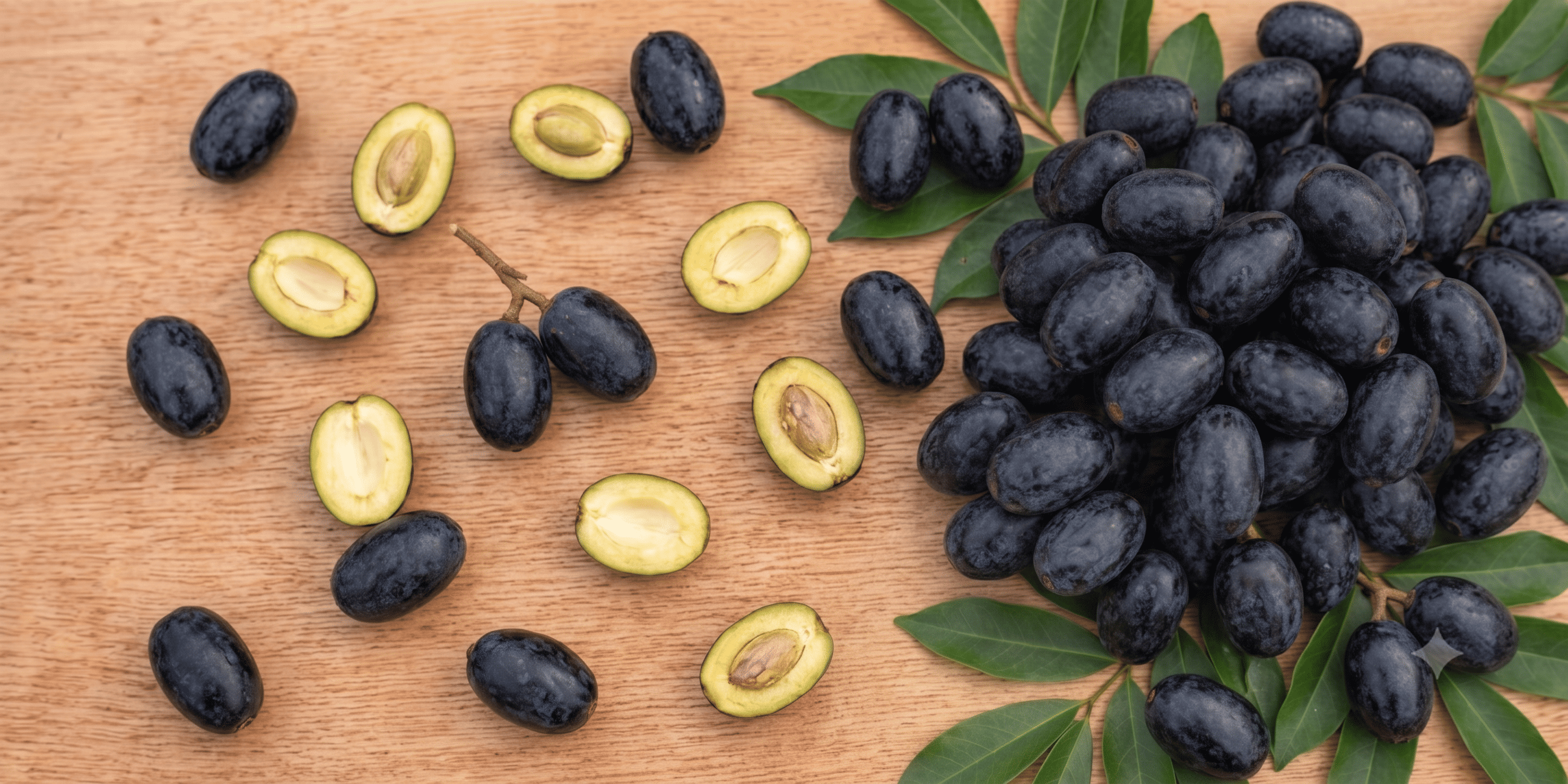
Physically, Dabai (Canarium odontophyllum) beautifully mimics the appearance of a large, gourmet European black olive. It features a thin, deep purple-black skin covering a bright, golden-yellow flesh and a hard, three-sided central seed.
While it grows naturally across the shared island of Borneo—going by names like Kembayau in Sabah and Brunei, or Kurihang in Kalimantan—Sarawak is the undisputed cultural and commercial heartland of the fruit.
But here is the most fascinating part: It is not a fruit in the traditional, sugary sense. Entirely free of high-fructose sweetness, Dabai eats exactly like a rich, velvety avocado. When you break down its science, it acts as a dual-action cellular shield for the two most vital organs in your body.
The Health Benefits of Dabai for Heart Longevity
The creamy yellow pulp of the Dabai fruit is a literal goldmine for cardiovascular longevity, heavily mirroring the elite lipid profiles of avocados and extra virgin olive oil.
The Power of Omega-9
Dabai pulp is exceptionally high in monounsaturated fatty acids (MUFAs), dominated specifically by Oleic Acid. These are the foundational “good fats” your body requires to maintain cellular fluid integrity, support efficient hormone transport, and lower systemic inflammation.
Clearing the Arteries
In rigorous in vivo biomedical studies conducted by premier Malaysian universities, subjects fed a high-cholesterol diet supplemented with Dabai pulp showed a massive reduction in plasma Total Cholesterol and LDL (“bad”) cholesterol.
Plaque Prevention
Most impressively, the research demonstrated a profound reduction in the formation of fatty plaques within the aorta. The perfect natural combination of its monounsaturated fats and high Vitamin E content protects blood vessels from lipid peroxidation, keeping your arteries clean, flexible, and healthy.
How Dabai Antioxidants Support Brain Health
While the yellow flesh protects your cardiovascular system from the chest down, the intense, dark purple-black skin of the Dabai fruit serves as high-performance fuel for your mind.
Heavy-Hitting Anthocyanins
The striking dark coloration of the skin is caused by an extraordinarily high concentration of anthocyanins—the exact same class of elite, anti-aging antioxidants found in wild blueberries, acai berries, and blackberries.
Crossing the Blood-Brain Barrier
Advanced chemical profiling has identified Cyanidin-3-O-glucoside as the dominant antioxidant in Dabai skin. These specific hydrophilic compounds are highly bioavailable, meaning they are capable of crossing the tight junctions of the human blood-brain barrier to directly neutralize free radicals and mitigate neuro-inflammation.
Banishing Brain Fog
From a pharmacological perspective, Dabai extracts have demonstrated promising anti-acetylcholinesterase activity. By naturally slowing down the enzyme that breaks down acetylcholine—the critical neurotransmitter responsible for learning, focus, and memory recall—Dabai acts as a natural shield against cognitive fatigue, sharp mental decline, and daily brain fog.
Bring Borneo to Your Plate
My journey with Dabai taught me that nature always provides local answers to global health trends. We don’t always need to look halfway across the world for expensive, imported, trendy superfoods when the rainforests of Borneo have already perfected a whole food that does it all.
If you are lucky enough to be in Sarawak during the fruiting season, or if you spot authentic Dabai paste or Nasi Goreng Dabai on a local menu, don’t hesitate.
Eat the deep purple skin for your mind. Savor the golden flesh for your heart. Feed your cells, protect your longevity, and experience the ultimate union of heart and mind.
By Chun Ting from Khasiat
Chun Ting is a Malaysian Registered Nutritionist specializing in regional public health and metabolic wellness. Over a 20-year career spanning Southeast Asia, he knows that the secret to healthy communities isn’t found in imported wellness trends—it’s found locally. Backed by a Bachelor’s from Universiti Putra Malaysia (UPM) and a Master’s from the London School of Hygiene & Tropical Medicine (LSHTM), Chun Ting bridges the gap between complex science and daily life—translating nutritional data into fun, practical lifestyle hacks that protect both your health and your love for local food.