

Who says eating healthy means skipping dessert? Better yet, who says dessert can’t be actively good for you?
Meet grass jelly—a glossy, dark gem known by many names across Southeast Asia. Whether you call it Cincau (Malay, Indonesian & Singaporean), ꦗꦁꦒꦼꦭꦤ꧀ – Janggelan (Javanese), เฉาก๊วย – Chao Kuai (Thai), Sương sáo (Vietnamese), or 仙草 – Xiān Cǎo (Mandarin, which beautifully translates to “Divine Grass”), it turns out that your gut microbiome absolutely loves it.
The Plant Behind the Jelly
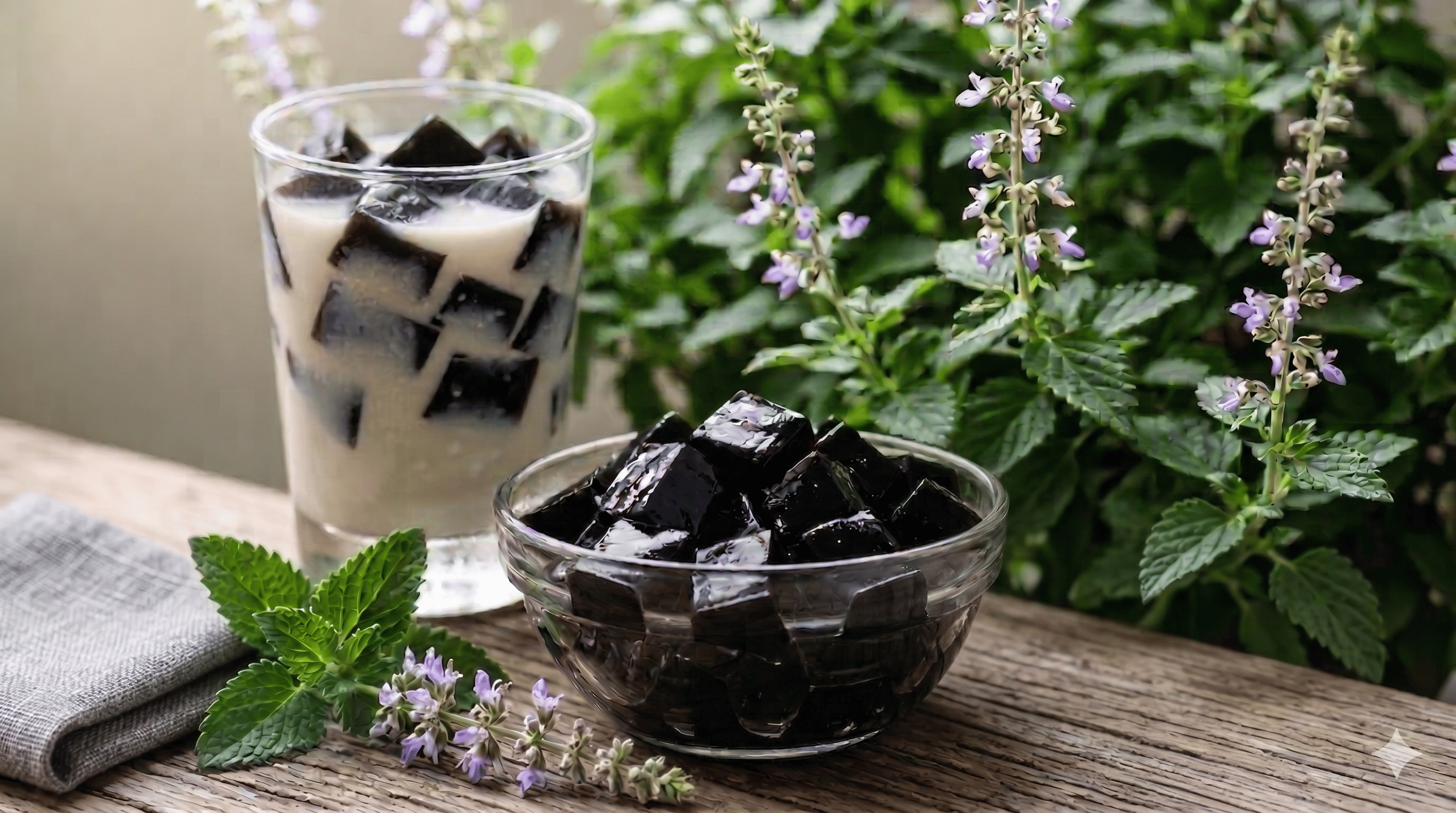
Many people have never actually seen the plant before and only know the dark, jiggly cubes. Despite its dark appearance and wonderfully gelatinous texture, grass jelly contains zero animal products. It is 100% plant-based, made by boiling down the dried stalks and leaves of a humble herb from the mint family called Platostoma palustre (historically known as Mesona chinensis).
To make it, the harvested plants are sun-dried and aged to develop their deep, herbal flavor. They are then simmered for hours, naturally releasing their own rich gelling agents. With just a tiny touch of starch added to help it set, the liquid cools into the firm, refreshing blocks we see at the markets.
Why Your Gut Microbiome Loves Grass Jelly
To keep your gut microbiome thriving and your digestion running smoothly, you need to feed your good bacteria the right fuel. Here is how grass jelly does exactly that:
1. Pectin – The Premium Prebiotic
If you’ve ever eaten an apple to support your digestion, you are already familiar with pectin. Grass jelly is naturally packed with this highly effective soluble dietary fiber.
Pectin acts as a prebiotic—meaning it is essentially gourmet food for the good bacteria (like Bifidobacteria and Lactobacillus) living in your large intestine. A standard dense serving of grass jelly delivers 2 to 3 grams of soluble fiber straight to your gut microbes. When they feast on this fiber, they produce short-chain fatty acids (SCFAs) like butyrate, which strengthen your gut barrier and reduce systemic inflammation.
2. Soothing Shield for Your Stomach
When grass jelly enters your stomach, your digestive juices break down its solid structure, releasing the soluble pectin. This fiber then forms a slick, viscous, gel-like solution that naturally coats your stomach and intestinal lining. If you suffer from mild gastritis, acid reflux, or GERD, this natural barrier helps buffer excess stomach acid, giving your irritated tissues a chance to rest and heal.
3. Polyphenols Lower Gut Inflammation
Don’t just think of grass jelly as fiber; it’s also a reservoir of specific, bio-available antioxidants:
- Rosmarinic Acid & Caffeic Acid: These heavy-hitting plant polyphenols are celebrated for their natural anti-inflammatory properties. (Fun fact: Rosmarinic acid is the exact same soothing compound that gives herbs like rosemary, thyme, and mint their health perks, while caffeic acid is the powerful cellular protector found in coffee and blueberries!)
- Flavonoids (like Isoquercitrin): These molecules actively fight oxidative stress in the gut. Isoquercitrin is a premium, highly absorbable form of quercetin—the same prized immune-boosting flavonoid you get when you eat unpeeled apples, red onions, or sip green tea.
When your gut lining is inflamed due to stress or a poor diet, your entire microbiome suffers. The anti-inflammatory compounds in grass jelly help soothe this inflammation at a cellular level. This perfectly aligns with Traditional Chinese Medicine, which has used 仙草 Xiān Cǎo for centuries to clear “internal heatiness” and calm a sluggish, overheated digestive system.
4. Low-Calorie, Zero Bloat
Many modern desserts are heavy in dairy, refined fats, and artificial sweeteners, which can cause painful gas, bloating, and dysbiosis (microbiome imbalance). Pure grass jelly is roughly 95% water, sugar-free, and fat-free, containing just 30 to 40 calories per 100 grams. It has an incredibly low glycemic index. It provides the physical chew, volume, and psychological satisfaction of a heavy dessert, without triggering the bloating or blood sugar spikes that upset your gut.
Keep Your Dessert Healthy
Buying canned grass jelly or ordering it drenched in condensed milk from a local hawker stall turns this prebiotic superpower into a sugar bomb that actually feeds the bad bacteria in your gut.
Instead, buy raw, unsweetened grass jelly blocks from your local wet market or Asian grocer. Bring it home, slice it into cubes, and pair it with gut-friendly, wholesome ingredients:
- Toss it into a glass of chilled, unsweetened organic soy milk, or pair it beautifully with a warm bowl of silky taufufa (bean curd).
- Serve it cold with a splash of fresh, naturally sweet coconut water for added electrolytes.
- Squeeze fresh lime juice over it for a citrusy kick.
- Or simply cut it into cubes and enjoy it clean alongside fresh fruit platters.
Eating healthy doesn’t mean giving up dessert. By embracing grass jelly, you get to end your meal with a cool, bouncy, refreshing treat that tastes like a cheat day, but acts like a prebiotic supplement. Your sweet tooth stays satisfied, and your gut microbiome will thank you!
By Chun Ting from Khasiat
Chun Ting is a Malaysian Registered Nutritionist specializing in regional public health and metabolic wellness. Over a 20-year career spanning Southeast Asia, he knows that the secret to healthy communities isn’t found in imported wellness trends—it’s found locally. Backed by a Bachelor’s from Universiti Putra Malaysia (UPM) and a Master’s from the London School of Hygiene & Tropical Medicine (LSHTM), Chun Ting bridges the gap between complex science and daily life—translating nutritional data into fun, practical lifestyle hacks that protect both your health and your love for local food.