
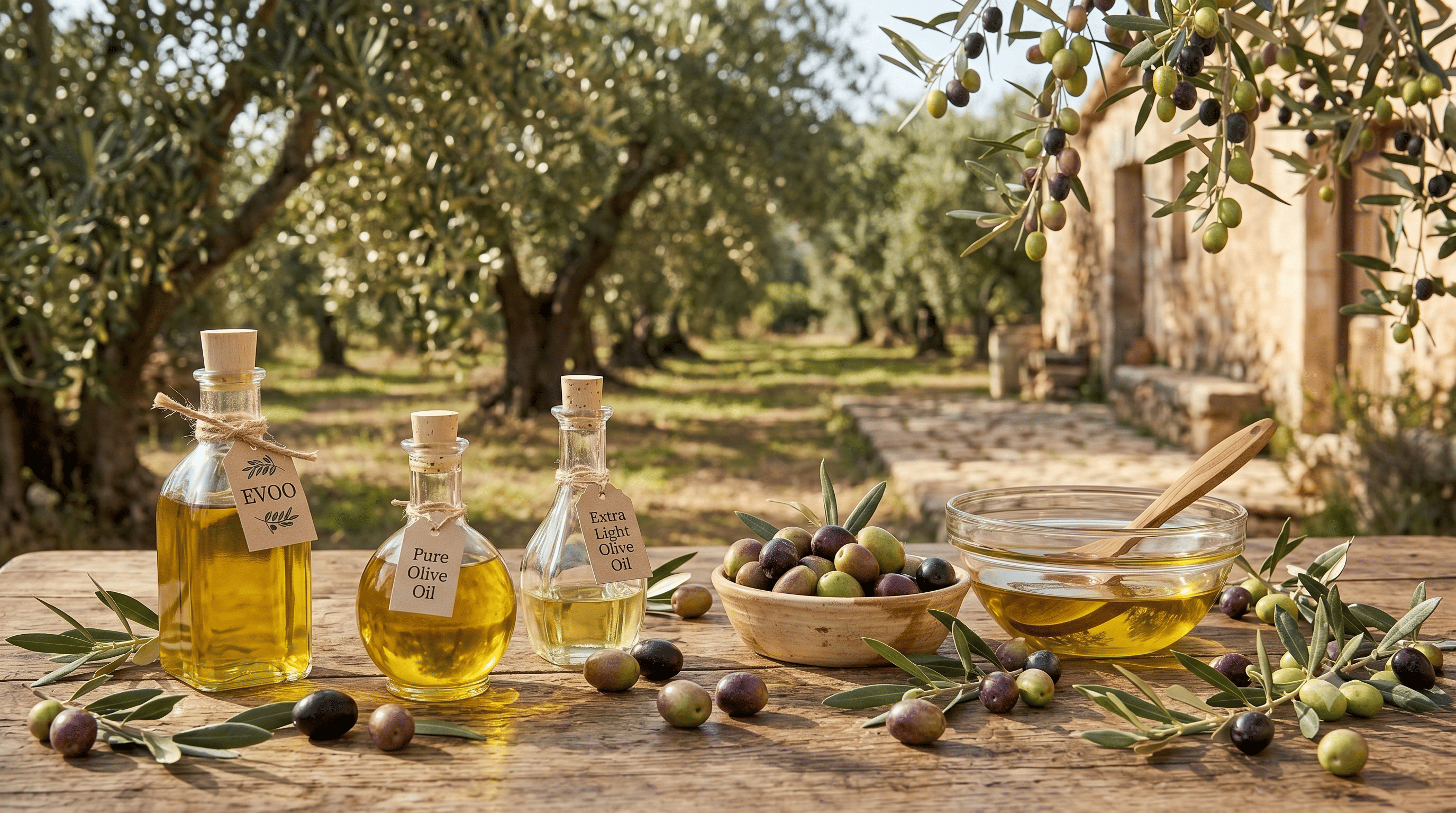

When shopping for olive oil at the supermarket, many consumers make purchasing decisions based on common assumptions. Labels like “Pure” or “Extra Light” often lead to confusion regarding the actual nutritional value and health benefits of the oil.
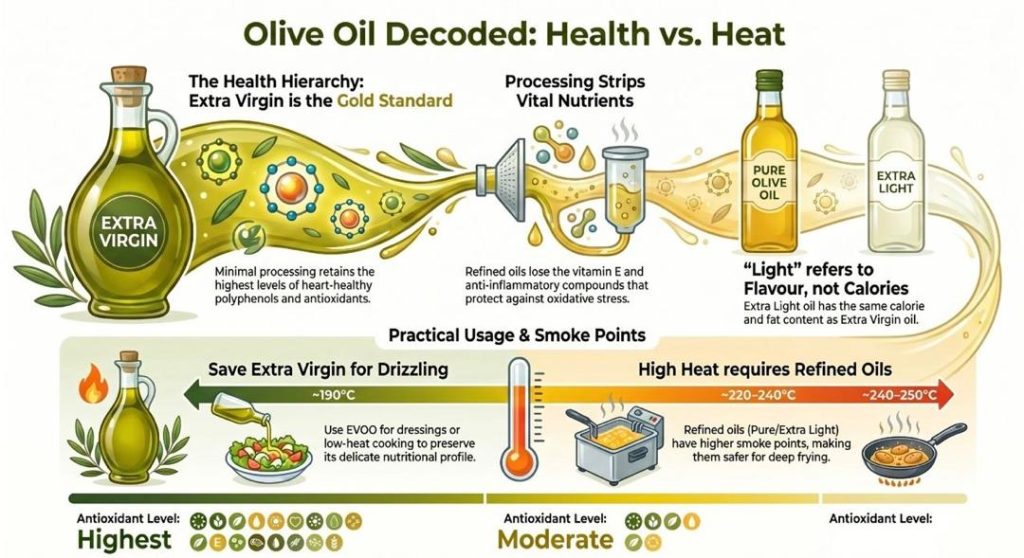
Quick Summary: The main difference between olive oils lies entirely in how much processing they undergo. As a general rule, the less processed the olive oil, the more natural antioxidants and beneficial plant compounds it retains. Therefore, “Extra Light” is not a diet oil—it is simply highly processed.
🔍 Fact vs. Myth: Debunking Supermarket Labels
Before looking at the rankings, let’s correct three widespread misconceptions:
- Myth: “Pure Olive Oil” is the purest, highest quality form available.
👉 Fact: It is actually a commercial blend of refined oil and a small amount of virgin oil. - Myth: “Extra Light Olive Oil” is lower in calories and fat, making it healthier.
👉 Fact: It contains virtually the same calories and fat as all other olive oils; “Light” only refers to color and taste. - Myth: All olive oils provide the exact same therapeutic health benefits.
👉 Fact: Processing strips away the protective compounds that give olive oil its unique health benefits.
The Definitive Olive Oil Health Ranking
Below is an evidence-based nutritional breakdown and ranking of the three most commonly available olive oils, ranked from highest to lowest health benefit.
🥇 #1 Extra Virgin Olive Oil (EVOO)
Extra Virgin Olive Oil is clinically recognized as the highest-quality olive oil available. It is produced strictly through mechanical cold pressing without extensive refining, allowing it to retain its maximum nutrient density.
- Nutritional Profile: It contains the highest amount of olive polyphenols, is rich in vitamin E, and yields the highest overall antioxidant activity.
- Health Benefits: Strong evidence links it to heart health, improved blood lipid profiles, reduced chronic inflammation, and protection against cellular oxidative damage. Research suggests many of the benefits of the Mediterranean diet are directly linked to EVOO’s high polyphenol content.
- Best Culinary Uses: Best used for salad dressings, dipping bread, drizzling over food, and low-to-medium heat cooking.
- Smoke Point: Approximately 190°C. While it can be used for normal cooking, prolonged high-temperature frying may reduce its beneficial antioxidants.
🥈 #2 Pure Olive Oil
Despite the word “Pure,” this product does not mean “100% pure quality”. It is a practical everyday cooking oil that offers some benefits of olive oil, but with fewer protective compounds than Extra Virgin.
- Nutritional Profile: The refining process removes a significant portion of its naturally occurring antioxidants, polyphenols, and flavor compounds. Compared to EVOO, it has lower polyphenol, antioxidant, and vitamin E levels.
- Health Benefits: While lower in antioxidants, it still maintains a favorable fatty acid profile, particularly rich in heart-friendly monounsaturated fats.
- Best Culinary Uses: Excellent for stir-frying, pan-frying, and general everyday cooking where a milder taste is preferred.
- Smoke Point: Approximately 220–240°C.
🥉 #3 Extra Light Olive Oil
This is the most misunderstood olive oil on the shelf. The term “Light” simply denotes a lighter color, lighter taste, and a highly neutral flavor profile.
- Nutritional Profile: This oil undergoes extensive refining, which strips away almost all of its natural flavor, aroma, and antioxidant compounds. It possesses the lowest polyphenol and antioxidant content of all three grades.
- Health Benefits: It offers minimal antioxidant protection, though it still provides basic monounsaturated fats. Its primary advantage is structural stability rather than medicinal value.
- Best Culinary Uses: Deep frying, baking, and high-temperature cooking where a neutral flavor is required.
- Smoke Point: Approximately 240–250°C.
Summary Comparison Table
| Rank | Olive Oil Type | Antioxidant & Polyphenol Levels | Best Culinary Application | Smoke Point |
|---|---|---|---|---|
| 🥇 1st | Extra Virgin (EVOO) | Highest Retention | Drizzling, dressings, light sautéing | ~190°C |
| 🥈 2nd | Pure Olive Oil | Moderate (Partially Stripped) | Stir-frying, pan-frying, general cooking | ~220–240°C |
| 🥉 3rd | Extra Light Olive Oil | Lowest (Extensively Refined) | Deep-frying, baking, high-heat cooking | ~240–250°C |
Dietitian’s Take
From a dietary standpoint, all three types of olive oil are beneficial because they predominantly consist of monounsaturated fats, which are healthier than saturated fats. However, if your primary goal is to maximize therapeutic health benefits—specifically targeting anti-inflammatory properties, cardiovascular protection, and high antioxidant intake—Extra Virgin Olive Oil remains the gold standard.
Always remember: Olive oil is not just about the fat content. The true health advantage comes directly from the unrefined polyphenols and antioxidants. The less processing the oil undergoes, the more protective health compounds remain to benefit your body.
By Ethan Lee Yong Khang from Khasiat
Mr. Ethan Lee Yong Khang is a Malaysian dietitian and health educator with a Bachelor’s Degree in Dietetics from Universiti Tunku Abdul Rahman (UTAR). Passionate about making nutrition science practical and accessible, he translates evidence-based research into simple, actionable strategies for healthier living. His work focuses on metabolic health, weight management, and preventive nutrition, empowering individuals to build sustainable habits while enjoying the foods they love.