
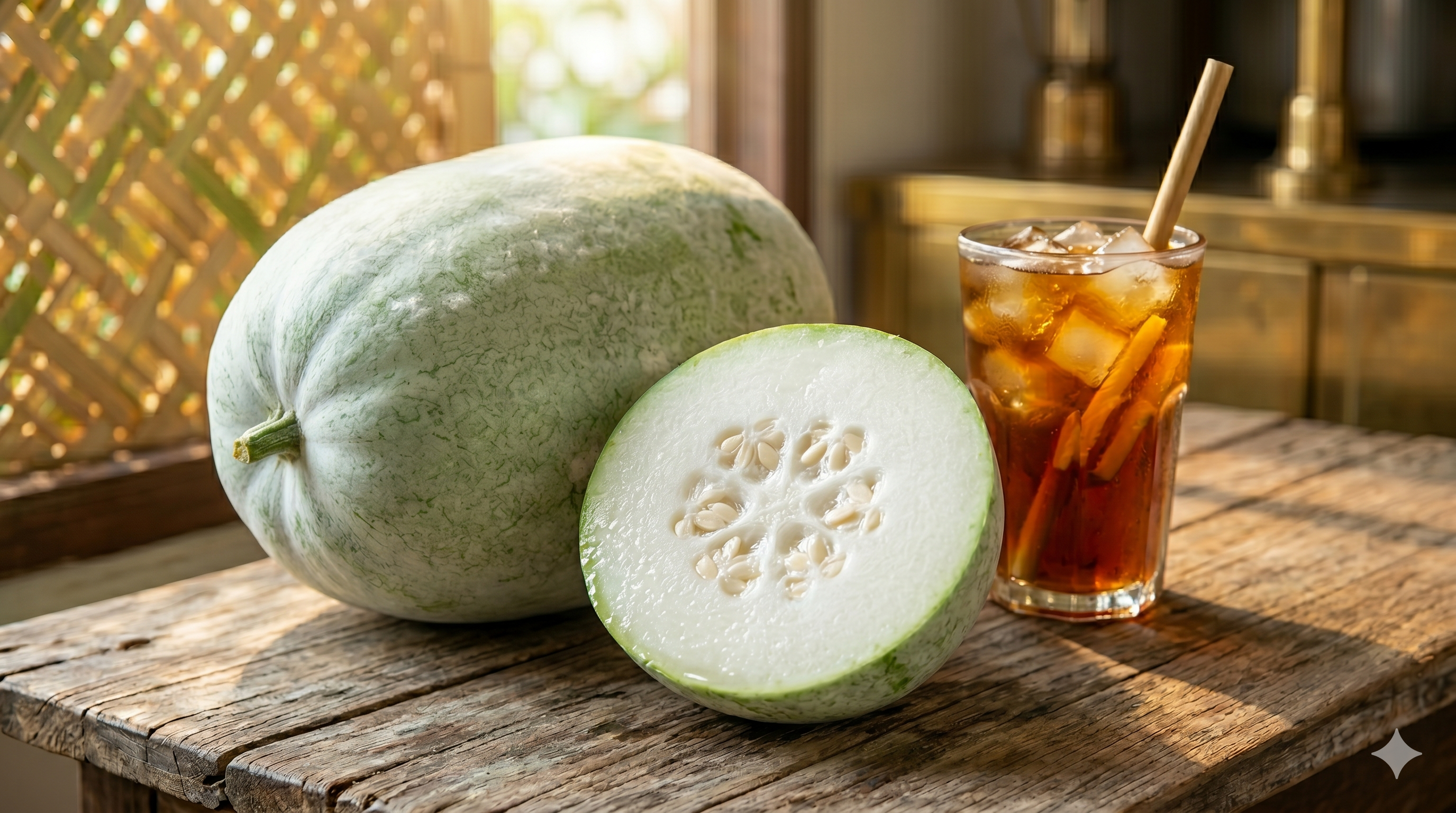

If you walk into any modern bubble tea shop, step into a local kopitiam, or grab a brick-pack from the grocery store today, you’ll notice a sweet, caramelized, ice-cold classic making a massive comeback: Teh Buah Kundur (Winter Melon Tea).
But have you ever looked at that amber-colored liquid and wondered: Is Buah Kundur actually just a base for a sweet drink? Or are we completely missing the point of what this giant fruit can do for our bodies?
The Story Behind the Sip: A 150-Year-Old Savior
Long before modern air conditioning, refrigerators, or commercial soda existed, people living in hot, humid climates had to find natural ways to survive the heat.
During the Qing Dynasty, laborers and farmers in Southern China and Taiwan worked under a punishing sun. Because raw water was unsafe and packed with pathogens, boiling everything was a survival rule.
To make plain boiled water exciting—and to combat “heatiness”—creative cooks began slow-simmering a giant, local gourd with brown sugar for hours.
They discovered that the porous melon acted like a literal flavor sponge. It completely absorbed the sugar, caramelized into a deep amber syrup, and created a cooling elixir that instantly soothed a parched throat. For over a century, it ruled alongside sugarcane juice as Asia’s ultimate traditional heat-buster.
Dissecting This Giant Melon
So, what actually is Buah Kundur? Globally known as the winter melon, ash gourd, or wax gourd (Benincasa hispida), this fruit is an absolute unit.
These melons are literal garden giants, growing up to 1 meter long and weighing up to 20 kg—roughly the size of a human toddler! In ancient times, because they grew on overhead trellises, a falling winter melon was a genuine safety hazard.
Slice one open and you’ll find crisp, snow-white flesh that is 96% water. Bite it raw, and it’s remarkably underwhelming—tasting exactly like the crunchy, flavorless white rind of a watermelon.
But that neutrality is its superpower. Because it is highly porous, it acts like a culinary shape-shifter. In a savory soup, it absorbs rich pork broth; in an Indian kitchen, it becomes a translucent candy called Petha; and at the kopitiam, it transforms into the sweet, caramelized tea we all love.
What Does it Actually Do for Your Health?
It’s easy to look at a fruit that is 96% water and assume it’s just a refreshing, low-calorie snack. But under a microscope, raw Buah Kundur functions like a complex biological kit, containing unique compounds that directly interact with our cells:
- The Skeletal Construction Crew: Our bones are constantly being broken down and rebuilt by opposing cellular teams. Researchers isolated a compound in this melon called 2-furoic acid and tested it against bone-forming cells. The data revealed that the extract significantly accelerated the mineralization and building of new bone cells, while simultaneously blocking the specialized pathways that cause bone loss.
- Neuroprotection and Stress Receptors: On a neurological level, the melon contains complex pectic polysaccharides (like homogalacturonan) that have been shown to interact with acetylcholinesterase (AChE) receptors in the brain—the specific pathways heavily tied to stress and anxiety management. Furthermore, its concentrated antioxidants shield neurons from the oxidative damage associated with cognitive decline and aging.
- Metabolic and Tissue Defense: The outer peel holds a heavy concentration of flavonoids that act as natural anti-inflammatories. Recent pharmacological studies also indicate that active peptides within the pulp act as metabolic regulators, effectively helping to inhibit lipid (fat) accumulation within cells.
The Modern Catch: Rethinking Your Next Sip
While the raw melon is a low-calorie, cell-protecting marvel, the Teh Buah Kundur we love is a different story. It is a concentrated syrup born from hours of boiling with massive amounts of sugar.
While 19th-century laborers needed those heavy calories to fuel a day of intense farming, our modern, sedentary lifestyles don’t. Drinking it heavily sweetened every day is a fast track to blood sugar spikes and crashes.
Buah Kundur is far more than a passing drink trend; it is a biological powerhouse.
To truly experience its health benefits, try it the savory way—stewed in clear broths, soups, or curries where it can act as a flavor sponge without the sugar overload. And the next time you order that ice-cold kopitiam drink, treat it for what it truly is: a historic, delicious cultural dessert to be enjoyed in moderation.
By Chun Ting from Khasiat
Chun Ting is a Malaysian Registered Nutritionist specializing in regional public health and metabolic wellness. Over a 20-year career spanning Southeast Asia, he knows that the secret to healthy communities isn’t found in imported wellness trends—it’s found locally. Backed by a Bachelor’s from Universiti Putra Malaysia (UPM) and a Master’s from the London School of Hygiene & Tropical Medicine (LSHTM), Chun Ting bridges the gap between complex science and daily life—translating nutritional data into fun, practical lifestyle hacks that protect both your health and your love for local food.