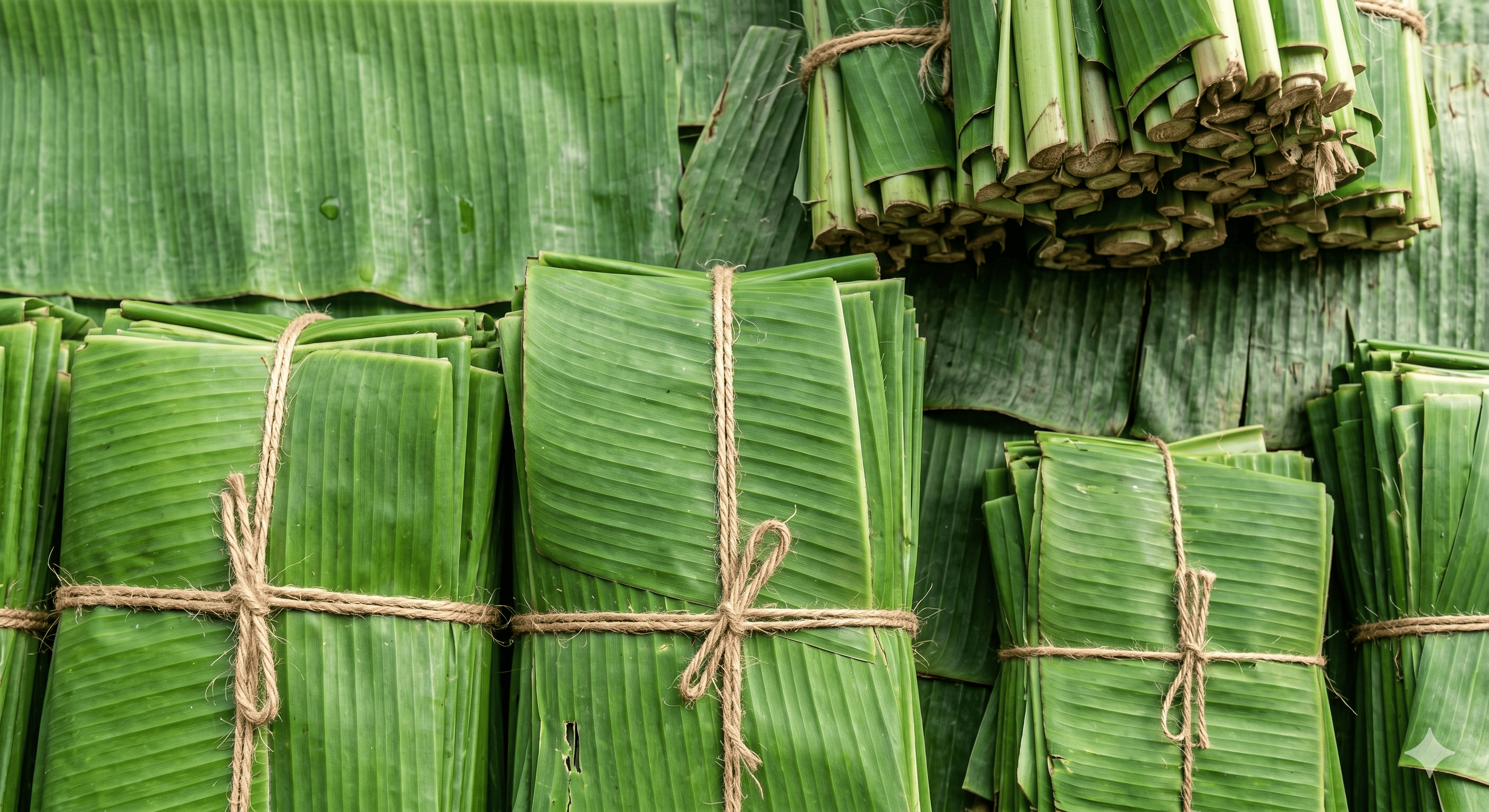

Across Southeast Asia, the banana leaf is absolutely everywhere. Think of a perfectly wrapped Nasi Lemak Bungkus shaped into a tight pyramid trapping that signature fragrant steam, a large emerald-green leaf spreading across the table at your favorite banana leaf rice spot, tiny folded boxes of Otak-Otak or Thai Hor Mok, or the beautifully charred leaf wrapping your Ikan Bakar or Pulut Panggang.
To the modern eye, it looks like a simple, rustic aesthetic choice. But was our nenek moyang just playing a nostalgic trick on us? Or is there actually a secret magic hidden within the leaf that they understood best?
The Flavor Shift: Is It Just Marketing?
Let’s address the elephant in the room. When a street vendor serves you Char Kway Teow or Pad Thai on a piece of banana leaf, you automatically feel that the food has an authentic, traditional taste. You instantly judge it to taste better. But is that real, or is it just a clever marketing gimmick?
The answer: It is a literal chemical reaction.
Banana leaves are naturally coated in a microscopic, waxy plant layer called the cuticle. The moment piping hot food—like smoky noodles straight from a screaming hot wok—hits that leaf, the ambient heat melts this outer wax layer.
This melting process releases volatile organic compounds into the air, creating a distinct, sweet, and earthy aroma. In food science, this signature scent is driven by a natural compound called Hexanal (which creates that ultra-fresh, green-grass smell) blended with sweet plant phenols. Together, they create what scientists call a “green, herbaceous, and coumarinic” aromatic profile.
Because up to 80% of what our brain registers as “flavor” actually comes from our sense of smell, inhaling that warm, grassy hexanal scent while you eat fundamentally shifts your brain’s perception of the food. It tastes richer, smokier, and uniquely complex. It’s not marketing; it’s a sensory upgrade.
Meet Rutin: The Tea-Like Antioxidant from Banana Leave
When scientists put a banana leaf under a microscope, they don’t just see green fibers—they see a massive concentration of Polyphenols. The crown jewel of these compounds is a potent plant antioxidant called Rutin (the exact same heavy-hitting antioxidant found in premium green tea and dark berries).
We obviously cannot digest raw banana leaves directly. Even though the leaf contains equivalent quantities of antioxidants to other famous superfoods, we aren’t eating the leaf itself. However, the micro-dose that transfers to your food simply from touching it does provide a trace benefit to our health.
When your hot food or steam interacts with the leaf, a tiny, subtle layer of Rutin transfers onto the surface of your meal. In the human body, Rutin is famous for helping to lower blood pressure and reducing inflammation, meaning our nenek moyang were giving us a subtle wellness boost with every meal. Furthermore, that unique, herbaceous aroma activates your brain to start producing digestive enzymes before the food even hits your tongue, priming your stomach to digest your meal smoothly.
Natural Organic Antimicrobial
Long before modern refrigeration or chemical sanitizers existed, our ancestors used banana leaves for a very practical reason: keeping food fresh for as long as possible.
Modern laboratory testing shows that banana leaves possess powerful antimicrobial properties. The leaf is packed with natural defense chemicals like tannins and saponins, which are biologically designed to protect the plant from fungal and bacterial infections in hot, tropical climates.
When you wrap food in it, these compounds actively work to disrupt the cell membranes of common food-borne bacteria, including E. coli and Staphylococcus aureus (the main culprits behind food poisoning). It acts as a living, antibacterial shield that naturally slows down food spoilage.
The Cleanest Plate on Earth
Modern plastic takeout containers or styrofoam boxes are highly prone to leaching microplastics and chemical plasticizers directly into your hot food.
A banana leaf, on the other hand, requires nothing but a simple splash of clean water to be completely spotless. It is non-toxic, organic, chemically inert, and leaves absolutely zero footprint on your body or the planet.
The next time you unwrap a pyramid of Nasi Lemak or eat smoky noodles off a glossy green leaf, remember: you aren’t just experiencing culture. It’s a highly evolved piece of natural alchemy passed down from our nenek moyang that protects your health, elevates your palate, and honors the earth—one delicious bite at a time.
By Chun Ting from Khasiat
Chun Ting is a Malaysian Registered Nutritionist specializing in regional public health and metabolic wellness. Over a 20-year career spanning Southeast Asia, he knows that the secret to healthy communities isn’t found in imported wellness trends—it’s found locally. Backed by a Bachelor’s from Universiti Putra Malaysia (UPM) and a Master’s from the London School of Hygiene & Tropical Medicine (LSHTM), Chun Ting bridges the gap between complex science and daily life—translating nutritional data into fun, practical lifestyle hacks that protect both your health and your love for local food.